
 Just east of Zwolle, nestled amongst the country estates and between heathland and woodland, lies the municipality of Dalfsen. A green and friendly municipality with 30,000 residents who are known for putting their money where their mouth is. Bertus Meijer has his roots in the Overijsselse Vecht region and holds the position of Rural Area Manager at the municipality of Dalfsen.
Bertus has always had a passion for the outdoors. That’s the effect the beautiful green surroundings of Dalfsen have on you. And after a career as a gardener and natural stone worker, he joined the council in 2012. In 2015, he took the next step and became a Rural Area Supervisor. This means that every vehicle used in public spaces – from vans and tractors to mowers and articulated lorries – falls under his responsibility.
You’ll see us everywhere
“I love working with people. Making sure they can do what they’re good at. Empowering them,” Bertus begins. And there are quite a few of them. In total, there are now 76 people (including 36 from the sheltered workshop) working for the council on outdoor spaces. “Mowing lawns, repairing lighting, digging for works; you really see us everywhere. And because the council uses yellow buses, we stand out quite well,” Bertus continues.
Unfortunately, that’s not always a good thing. “If there’s damage to a car or something else has broken, we’re often blamed. Even though we haven’t been there at all. Try standing your ground with the insurer then.”
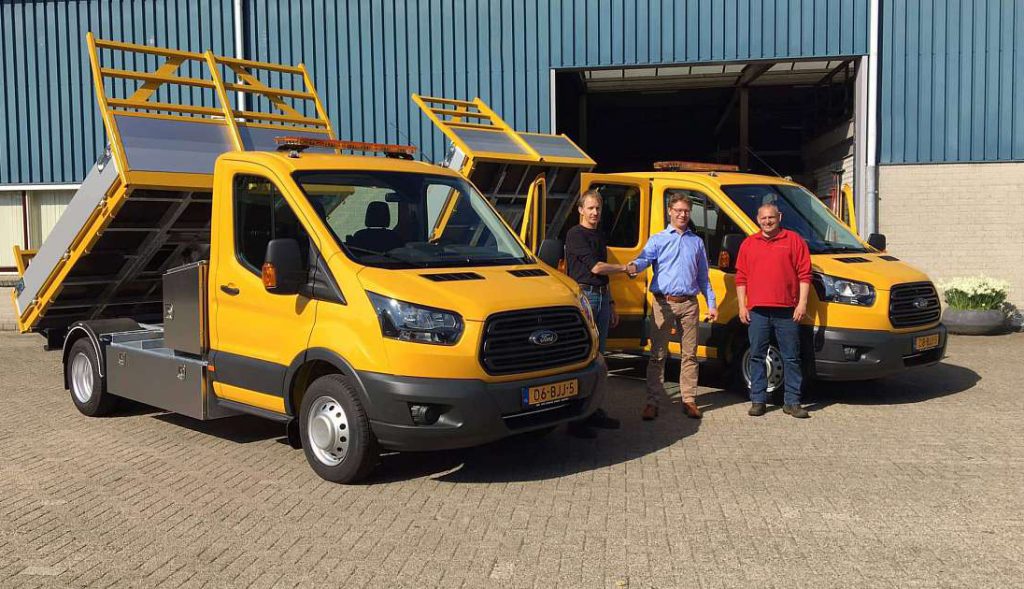
To gain insight into the movements of all vehicles, the municipality of Dalfsen started using TrackJack’s GPS trackers back in 2015. “This was because we purchased a shovel loader that had a GPS tracker fitted. The supplier could easily see when maintenance was required. It simply worked very well and did exactly what it was supposed to do.
When the tax authorities came to inspect and wanted to know whether the council’s buses were being used for commuting, we decided to fit a GPS tracker to everything that has wheels and an ignition. This way, we not only have visibility of the location of our machinery, but also a fully comprehensive mileage record for the tax authorities on our vehicles.
Bertus illustrates with a good example that GPS systems can be used for more than just mileage tracking and locating equipment. “Not long ago, we received a fine from the municipality of Tilburg. According to the fine, a car had been parked illegally there. We could easily see via the online account that the car hadn’t been there at all. Ultimately, the photo from the Ministry of Justice showed that someone had forged the number plate. That fine was quickly declared invalid.”
No checks, no threat
During the implementation of the tracking systems in 2015, there were quite a few questions from colleagues regarding their privacy. “But we made it very clear that we don’t monitor anyone and don’t even look at the systems at all if there’s nothing going on. If a problem arises, for example in the event of damage or complaints from residents, it’s good that we can always see which vehicle was there. And it has happened that damage was actually caused by us; we can easily see that too,” says Bertus.
To protect the privacy of its staff even better, Dalfsen Council does not use staff names. Only registration numbers. And for the equipment, it’s particularly useful to be able to keep an eye on it. “For instance, a weed burner is a popular target for thieves,” Bertus explains.

It’s just simple and works perfectly
“Back in 2015, we did have a few questions about how it worked. But now everything runs like clockwork. It works perfectly, it’s simple and does what it’s supposed to do. Nothing more and nothing less; we don’t want any other clutter. I don’t want people coming round trying to sell me extra stuff either. I decide for myself how much contact is needed. And that isn’t very much,” says a satisfied Bertus.
Naturally, the Municipality of Dalfsen is also looking to the future. CO2 emissions are playing an increasingly important role, and the switch to electric is being made slowly but surely. Yet they are trying to look at it critically. Bertus: “We look after our equipment well. Switching from a vehicle that still works fine but for which a new one has to be built isn’t sustainable in the long run either. You have to think differently. Don’t just throw everything away, but learn to think sustainably.”
Terug naar overzicht