
How does GPS work? This is how your tracker determines your exact location
GPS, or the Global Positioning System, is a global network of satellites that pinpoints your exact location. But how exactly does GPS work? In this guide, you’ll learn how satellites, signals and smart technology work together to determine your location quickly and accurately.
What is GPS?
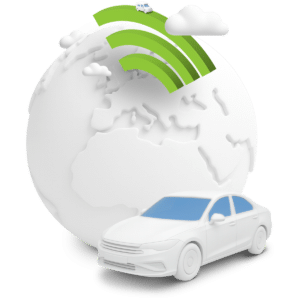
GPS is a system consisting of 32 satellites located approximately 20,200 kilometres above the Earth. Each satellite has its own radio transmitter and an atomic clock that can measure time to within three billionths of a second.
Thanks to their fixed orbits, there are always at least four GPS satellites above the horizon, wherever you are on Earth.
How does GPS positioning work?
Each satellite sends signals to Earth containing:
- The exact time the signal was transmitted
- The location of the satellite itself
- A unique ID for the satellite
A GPS receiver, for example in a GPS tracker, receives this signal. Because the signal travels at the speed of light, the receiver can calculate how far away it is from the satellite. By combining this data with the location of multiple satellites, an accurate calculation of your position is produced.
Why at least four satellites?
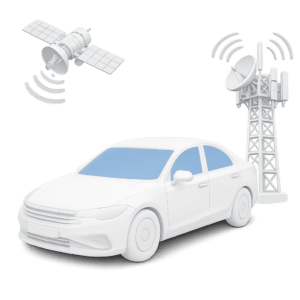
With just one satellite, the system only knows that you are somewhere on a spherical surface. Two satellites provide the intersection of two spheres. Add a third, and you get an exact position on a line. A fourth satellite also determines your altitude and increases accuracy.
TrackJack uses 14 to 20+ satellites simultaneously as standard, for optimal positioning.
Installation of your GPS system
For the system to work properly, it is important that your GPS tracker is installed in a location where the signal can be received unobstructed, but out of sight. Our technicians ensure correct installation at your premises, throughout the Netherlands. Read more about the TrackJack black box and how it is installed.
How does GPS tracking work in practice?
As soon as your GPS tracker knows your location, this information is sent via the mobile network to a secure online platform. Here you can:
- View the location live (track & trace)
- Review journeys
- Export mileage records to Excel or PDF
- Receive alerts for suspicious movements
This technology is used for cars, scooters, containers and heavy machinery, amongst other things. Read more about all the applications in our article on GPS tracking.
GPS trackers for various vehicles
TrackJack supplies GPS trackers for virtually any vehicle and object:
- GPS tracker for cars: journey logging, track & trace and theft protection
- GPS tracker for scooters: compact and easy to install
- GPS tracker for containers and heavy machinery: battery-powered, no power connection required
Frequently asked questions about GPS
How accurate is GPS?
TrackJack combines GPS with GLONASS (the Russian satellite network) for an average accuracy of 2 to 5 metres. In tunnels or dense urban areas, accuracy may temporarily decrease, but the system compensates for this as soon as the signal returns.
Does GPS also work abroad?
Yes. GPS is a global system and works anywhere on Earth. TrackJack transmits location data via the international mobile network, so you always have visibility of your vehicle, even abroad.
What is the difference between GPS and GLONASS?
GPS is the American satellite network, GLONASS the Russian one. TrackJack uses both systems simultaneously, ensuring more available satellites, better coverage and greater accuracy.
Does a GPS tracker always need an internet connection?
The tracker itself does not need an internet connection to determine its location: it does this via satellites. However, it does need a SIM card and a mobile network to transmit the location data to the online platform.
Want to test GPS tracking in practice?
TrackJack supplies GPS trackers for every vehicle and every application. Installation by our technicians, real-time insight and automatic journey logging.